Selected Works
This is a list of work that Ernest Hemingway published during his lifetime. While much of his later writing was published posthumously, they were finished without his supervision, unlike the works listed below:
- Three Stories and Ten Poems (1923)
- In Our Time (1925)
- The Torrents of Spring (1926)
- The Sun Also Rises (1926)
- Men Without Women (1927)
- A Farewell to Arms (1929)
- Death in the Afternoon (1932)
- Winner Take Nothing (1933)
- Green Hills of Africa (1935)
- To Have and Have Not (1937)
- The Fifth Column and the First Forty-Nine Stories (1938)
- For Whom the Bell Tolls (1940)
- Across the River and into the Trees (1950)
- The Old Man and the Sea (1952)
In Our Time
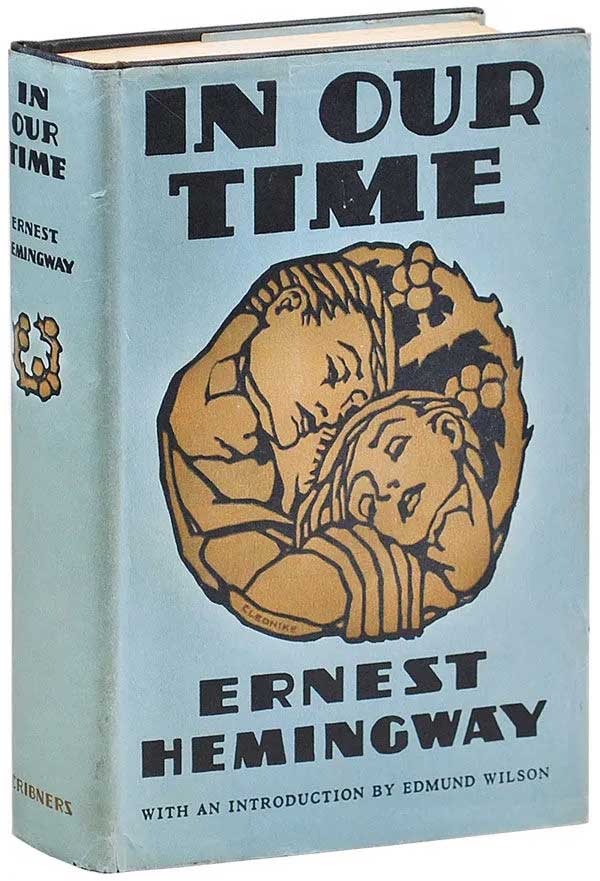
In Our Time is the title of Ernest Hemingway's first collection of short stories, published in 1925 by Boni & Liveright, New York, and of a collection of vignettes published in 1924 in France titled in our time. Its title is derived from the English Book of Common Prayer, "Give peace in our time, O Lord".
The collection's publication history was complex. It began with six prose vignettes published by Ezra Pound in the 1923 edition of The Little Review, to which Hemingway added twelve vignettes and had published in Paris in 1924 as the in our time edition (with a lower-case title). He wrote fourteen short stories for the 1925 edition, including "Indian Camp" and "Big Two-Hearted River", two of his best-known Nick Adams stories. He composed "On the Quai at Smyrna" for the 1930 edition.
The Old Man and the Sea
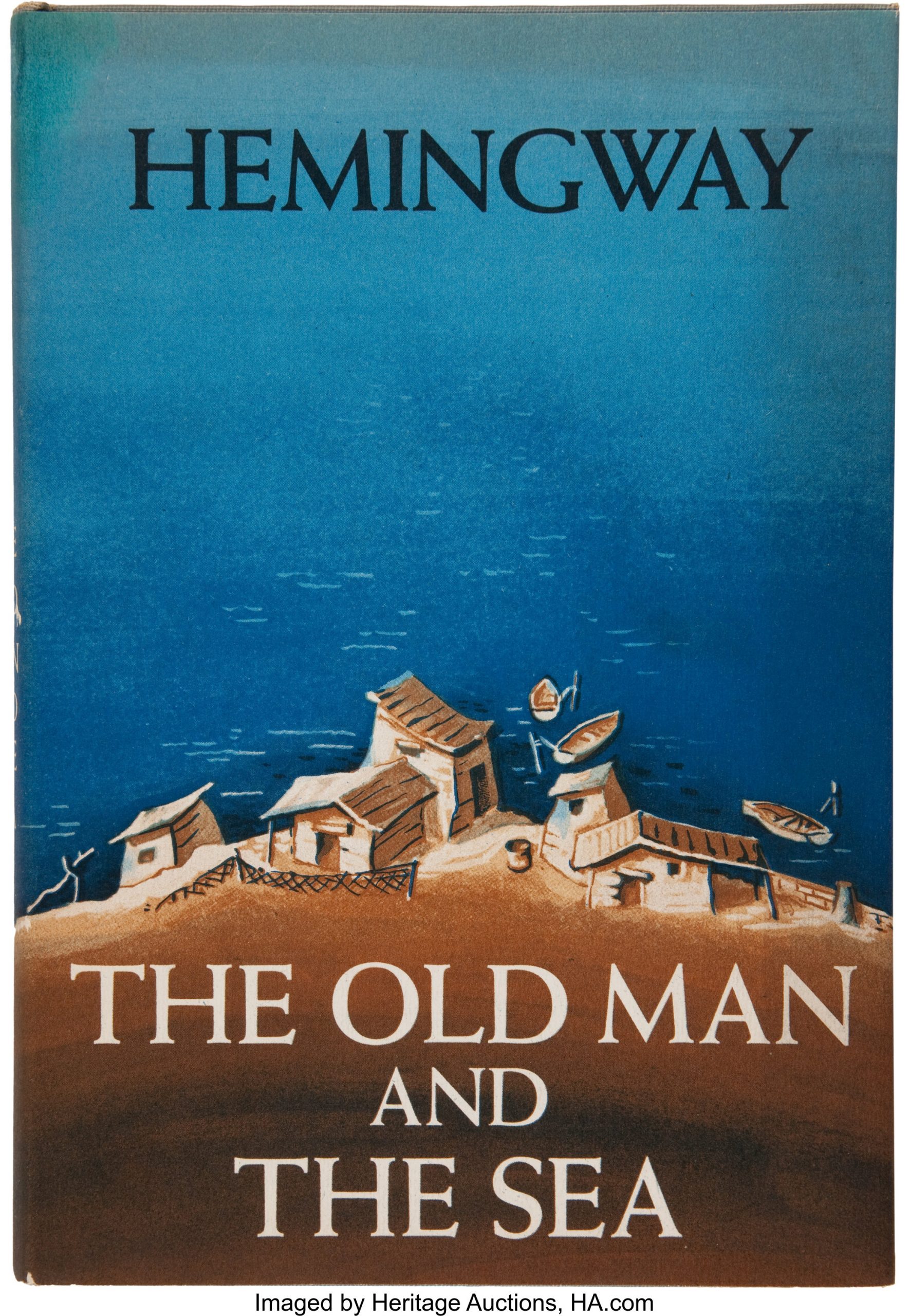
The Old Man and the Sea is a 1952 novella by the American author Ernest Hemingway. Written between December 1950 and February 1951, it was the last major fictional work Hemingway published during his lifetime. It tells the story of Santiago, an aging fisherman, and his long struggle to catch a giant marlin. The novella was highly anticipated and was released to record sales; the initial critical reception was equally positive, but attitudes have varied significantly since then.
Hemingway began writing The Old Man and the Sea in Cuba during a tumultuous period in his life. His previous novel Across the River and Into the Trees had met with negative reviews and, amid a breakdown in relations with his wife Mary, he had fallen in love with his muse Adriana Ivancich. Having completed one book of a planned "sea trilogy", Hemingway began to write as an addendum a story about an old man and a marlin that had originally been told to him fifteen years earlier. He wrote up to a thousand words a day, completing the 26,531-word manuscript in six weeks.
Over the following year, Hemingway became increasingly convinced that the manuscript would stand on its own as a novella. Life magazine published the full novella in its September 1, 1952 issue. Hemingway's publisher, Scribner's, released their first edition a week later on the 8th. Thanks to favorable early reviews and word-of-mouth, popular anticipation was so high that both releases were heavily bootlegged. The magazine sold a record 5.3 million copies in two days, while Scribner's sold tens of thousands of copies. Translated into nine languages by the end of 1952, The Old Man and the Sea remained on the New York Times bestseller list for six months. In 1953, it received the Pulitzer Prize for Fiction, and it was the only work explicitly mentioned when Hemingway was awarded the Nobel Prize in Literature in 1954.
Early reviews were positive, with many hailing what they saw as a return to form for Hemingway after Across the River's negative reception. The acclaim lessened over time, as literary critics began to think the initial reception overblown and over-enthusiastic. Whether The Old Man and the Sea is inferior or equal to Hemingway's other works has since been the subject of scholarly debate. Thematic analysis has focused on Christian imagery and symbolism, on the similarity of the novella's themes to its predecessors in the Hemingway canon, and on the character of the fisherman Santiago.
A Farewell to Arms
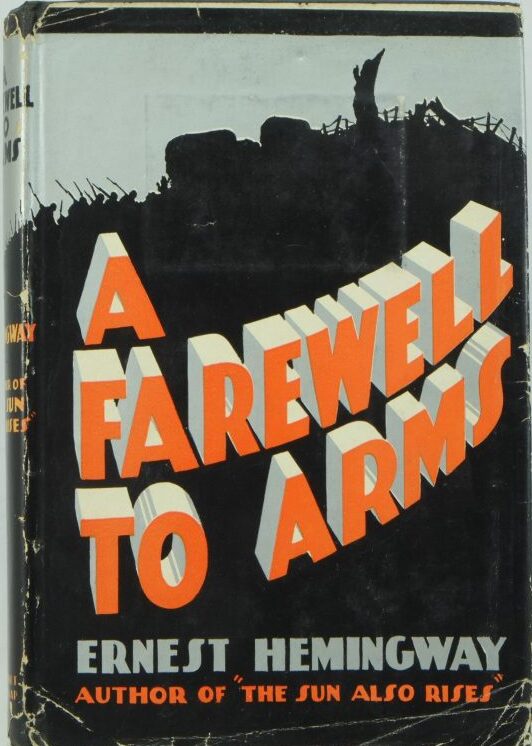
A Farewell to Arms is a novel by American writer Ernest Hemingway, set during the Italian campaign of World War I. First published in 1929, it is a first-person account of an American, Frederic Henry, serving as a lieutenant (Italian: tenente) in the ambulance corps of the Italian Army. The novel describes a love affair between the American expatriate and an English nurse, Catherine Barkley.
Its publication ensured Hemingway's place as a modern American writer of considerable stature. The book became his first best-seller and has been called "the premier American war novel from [...] World War I". The title might be taken from a 16th‑century poem of the same name by the English dramatist George Peele.
The novel has been adapted a number of times: initially for the stage in 1930; as a film in 1932, and again in 1957; and as a three-part television miniseries in 1966. The film In Love and War, made in 1996, depicts Hemingway's life in Italy as an ambulance driver in events prior to his writing of A Farewell to Arms.
As of January 1, 2025, A Farewell to Arms is in public domain.
For Whom the Bell Tolls
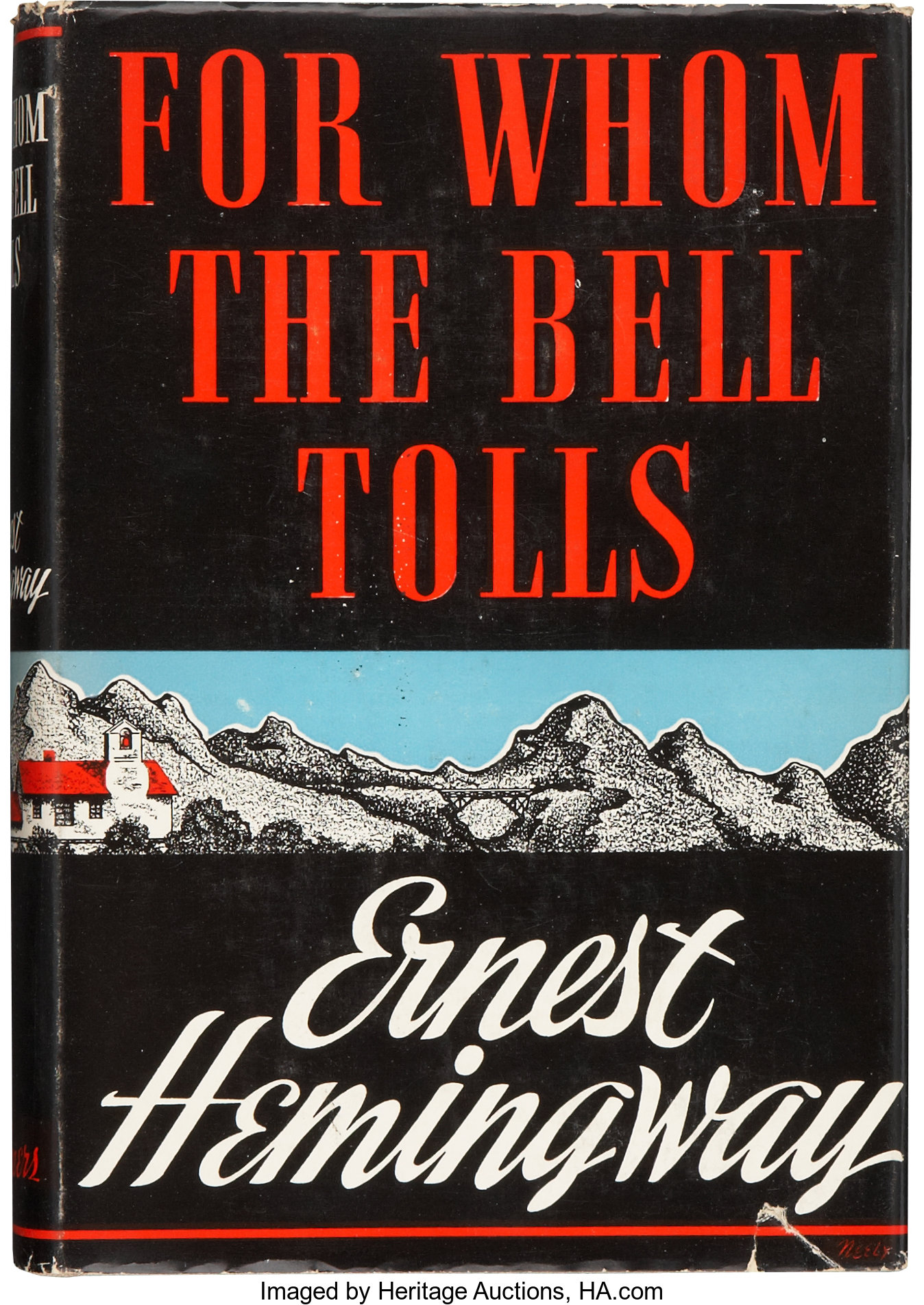
For Whom the Bell Tolls is a novel by Ernest Hemingway published in 1940. It tells the story of Robert Jordan, a young American volunteer attached to a Republican guerrilla unit during the Spanish Civil War. As a dynamiter, he is assigned to blow up a bridge during an attack on the city of Segovia.
It was published just after the end of the Spanish Civil War (1936–1939), whose general lines were well known at the time. It assumes the reader knows that the war was between the government of the Second Spanish Republic, which many foreigners went to Spain to help and which was supported by the Communist Soviet Union, and the Nationalist faction, which was supported by Nazi Germany and Fascist Italy. In 1940, the year the book was published, the United States had not yet entered World War II, which began on September 1, 1939, with Nazi Germany's invasion of Poland.
The novel is regarded as one of Hemingway's best works, along with The Sun Also Rises, A Farewell to Arms, and The Old Man and the Sea.
The Sun Also Rises
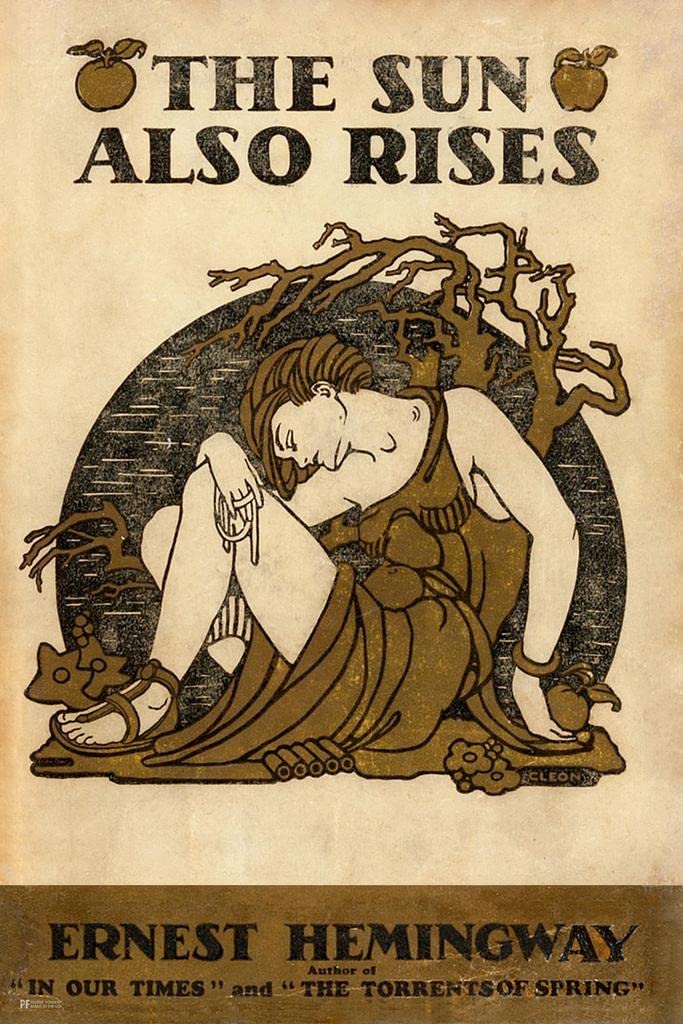
The Sun Also Rises is the first novel by the American writer Ernest Hemingway, following his experimental novel-in-fragments In Our Time (short story collection) (1925). It portrays American and British expatriates who travel from Paris to the Festival of San Fermín in Pamplona and watch the running of the bulls and the bullfights. An early modernist novel, it received mixed reviews upon publication. Hemingway biographer Jeffrey Meyers writes that it is now "recognized as Hemingway's greatest work," and Hemingway scholar Linda Wagner-Martin calls it his most important novel. The novel was published in the United States in October 1926, by Scribner's. A year later, Jonathan Cape published the novel in London under the title Fiesta. It remains in print.
The novel is a roman à clef: the characters are based on people in Hemingway's circle and the action is based on events, particularly Hemingway's life in Paris in the 1920s and a trip to Spain in 1925 for the Pamplona festival and fishing in the Pyrenees. Hemingway converted to Catholicism as he wrote the novel, and Jeffrey Herlihy-Mera notes that protagonist Jake Barnes, a Catholic, was "a vehicle for Hemingway to rehearse his own conversion, testing the emotions that would accompany one of the most important acts of his life." Hemingway presents his notion that the "Lost Generation"—considered to have been decadent, dissolute and irretrievably damaged by World War I—was in fact resilient and strong. Hemingway investigates the themes of love and death, the revivifying power of nature, and the concept of masculinity. His spare writing style, combined with his restrained use of description to convey characterizations and action, demonstrates his "Iceberg Theory" of writing.