The Modern Pencil
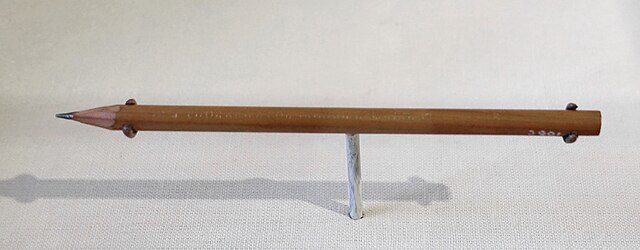
The modern pencil was invented in 1795 by Nicholas-Jacques Conte, a scientist serving in the army of Napoleon Bonaparte. The magic material that was so appropriate for the purpose was the form of pure carbon that we call graphite. It was first discovered in Europe, in Bavaria at the start of the fifteenth century; although the Aztecs had used it as a marker several hundred years earlier. Initially it was believed to be a form of lead and was called ‘plumbago’ or black lead (hence the ‘plumbers’ who mend our lead water-carrying pipes), a misnomer that still echoes in our talk of pencil ‘leads’. It was called graphite only in 1789, using the Greek word ‘graphein’ meaning ‘to write’. Pencil is an older word, derived from the Latin ‘pencillus’, meaning ‘little tail’, to describe the small ink brushes used for writing in the Middle Ages.
The purest deposits of lump graphite were found in Borrowdale near Keswick [England] in the Lake District in 1564 and spawned quite a smuggling industry and associated black economy in the area. During the nineteenth century a major pencil manufacturing industry developed around Keswick in order to exploit the high quality of the graphite.
The first factory opened in 1832, and the Cumberland Pencil Company has just celebrated its 175th anniversary; although the local mines have long been closed and supplies of the graphite used now come from Sri Lanka and other far away places. Cumberland pencils were those of the highest quality because the graphite used shed no dust and marked the paper very well.
Conte’s original process for manufacturing pencils involved roasting a mixture of water, clay and graphite in a kiln at 1,900 degrees Fahrenheit before encasing the resulting soft solid in a wooden surround. The shape of that surround can be square, polygonal or round, depending on the pencil’s intended use — carpenters don’t want round pencils that are going to roll off the workbench. The hardness or softness of the final pencil ‘lead’ can be determined by adjusting the relative fractions of clay and graphite in the roasting mixture. Commercial pencil manufacturers typically market 20 grades of pencil, from the softest, 9B, to the hardest 9H, with the most popular intermediate value, HB, lying midway between H and B. ‘H’ means hard and ‘B’ means black. The higher the B number, the more graphite gets left on the paper. There is also an ‘F’, or Fine point, which is a hard pencil for writing rather than drawing.